


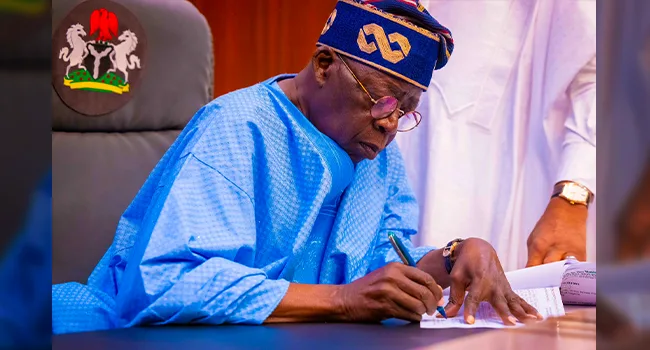
President Bola Tinubu has defended his administration’s plan to secure additional foreign loans, saying long-term investment in infrastructure is necessary to achieve Nigeria’s ambition of becoming a $1 trillion economy by 2030.
In a statement on the government’s infrastructure investment strategy, Tinubu said the proposed loans would fund roads, electricity improvements, port upgrades and other projects expected to create jobs, support businesses and expand economic opportunities.
His defence follows criticism from the Nigeria Labour Congress over the Federal Government’s request for National Assembly approval to borrow 20.5 billion dollars and 1.45 billion euros, despite increased revenue following the removal of petrol subsidy.
The President said the focus should be on what borrowed funds would achieve rather than the amount being borrowed. He listed the Lagos-Calabar Coastal Highway, Sokoto-Badagry Superhighway, Trans-Sahara Superhighway and electricity grid improvements among the projects expected to receive funding.
Tinubu said the Lagos-Calabar Coastal Highway could reduce transportation costs along its route by 15 to 20 per cent and contribute up to two per cent to Nigeria’s Gross Domestic Product. He also projected that the project could create about 100,000 direct jobs and more than 150,000 indirect jobs.
Related Posts:



The President also cited improvements in economic indicators, including second-quarter economic growth of 4.43 per cent in 2026 and a drop in headline inflation to 14.63 per cent in September. He said the country’s external reserves stood at 55.1 billion dollars as of October 9.
However, Tinubu acknowledged the pressure of debt servicing, which he said accounted for about 65 per cent of government revenue in the first half of 2026. He added that the government would seek longer-term loans and avoid using printed money to finance budget deficits.
Meanwhile, NLC President, Joe Ajaero, questioned the need for additional foreign loans, arguing that increased government revenue and higher crude oil prices should prompt the Federal Government to explain its borrowing plans.
Ajaero noted that the 2026 budget was based on an oil price benchmark of 70 dollars per barrel, while crude oil prices had risen above 100 dollars. He called for greater accountability but clarified that the labour union had no authority to approve or reject government borrowing.
Tinubu maintained that the success of the borrowing plan would depend on the completion of projects, value for money and improvements in the lives of Nigerians.