



The National Drug Law Enforcement Agency and the Australian Federal Police have signed a strategic agreement to dismantle international drug trafficking networks operating along the Nigeria-Australia route, with particular focus on methamphetamine and cocaine.
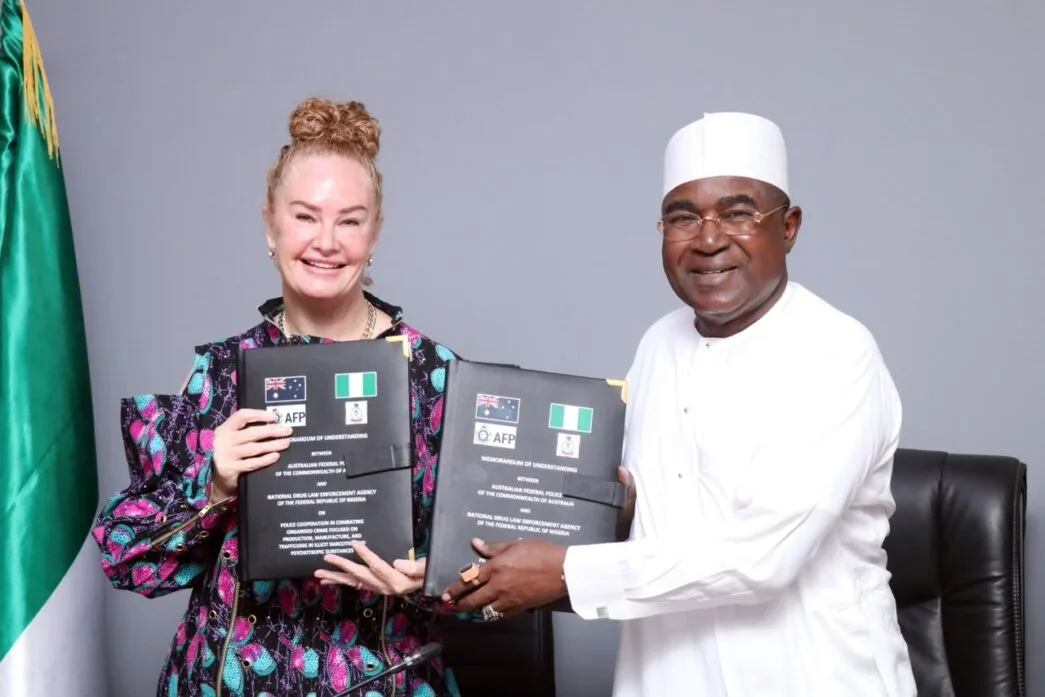
The agreement was formalised on Monday through the signing of a Memorandum of Understanding at the NDLEA national headquarters in Abuja.
NDLEA Chairman, Brigadier General Buba Marwa (retd.), described the partnership as a declaration of war against international drug cartels. He said it would strengthen the ability of both countries to track, disrupt and prosecute criminal networks involved in the movement of illicit drugs across borders.
Under the agreement, both agencies will collaborate on intelligence sharing, joint operations, capacity building and professional development. They will also conduct controlled deliveries of illicit consignments to support investigations and arrests.
Marwa said drug trafficking networks had become increasingly sophisticated, with Nigerian criminal groups developing links along the Australia-Pacific drug route. He expressed confidence that combining the international reach of the Australian Federal Police with the NDLEA’s operational capacity would make the route increasingly difficult for traffickers to exploit.
Related Posts:


The NDLEA chairman cited recent operations, including the seizure of 184.5 kilogrammes of cocaine intended for export and the dismantling of four methamphetamine laboratories. He said some of the laboratories allegedly had Mexican nationals involved in their operations, while one operation led to seizures valued at more than 360 million dollars.
He also highlighted the dismantling of a Switzerland-based drug cartel allegedly operated by a Nigerian, Simon Amadi, following more than a year of collaboration with the United States Drug Enforcement Administration and law enforcement agencies in France, Greece and Switzerland.
Head of the Australian Federal Police delegation, Sandra Booth, said tackling illicit drugs required a coordinated international response. She commended the NDLEA for combining enforcement operations with preventive interventions, describing the new agreement as an important boost to efforts against organised drug trafficking.
Booth warned that criminal organisations were using proceeds from drug trafficking to finance other serious crimes. She said vulnerable young people were being recruited to transport drugs and, in some cases, drawn into violent attacks against rival criminal groups.
She noted that the consequences of drug trafficking extended beyond addiction to include family breakdown, community instability, gang violence and deaths in Australia.
Booth said Australia was committed to working with Nigeria to prevent illicit drugs from reaching its territory and protect vulnerable populations.
The signing ceremony was attended by the Australian High Commissioner to Nigeria, Leilani Bin-Juda, Deputy High Commissioner Timothy Milikan, other members of the Australian delegation and senior NDLEA officials.