



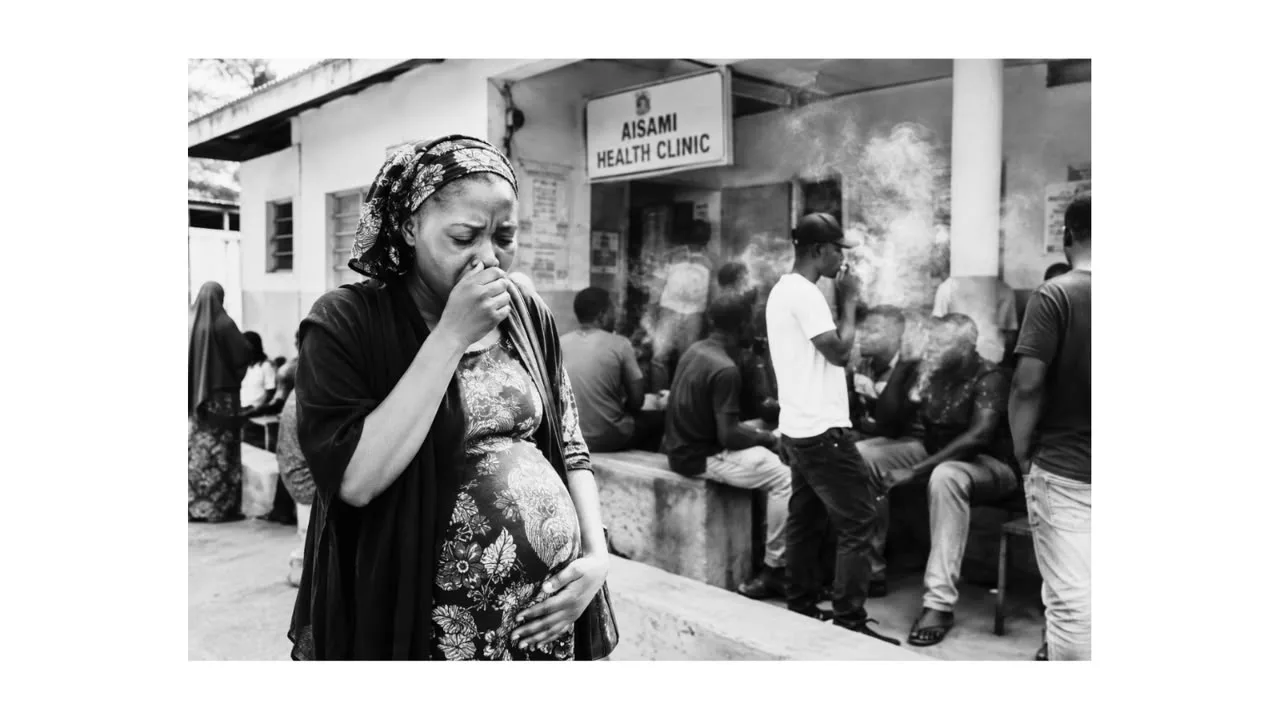
Pregnant and seeking routine antenatal care, Khadija Yunusa never expected a visit to Aisami Health Clinic in Sani Mai Nagge Ward, Gwale Local Government Area of Kano State, to leave her unwell. Beside the open, unfenced facility, a group of young men regularly gathered, and thick smoke from cigarettes and other products drifted into the clinic.
After inhaling the smoke, Khadija struggled to breathe, felt tightness in her chest, and began vomiting. Even after leaving the clinic, the vomiting continued that night, leaving her frightened for her unborn baby. The experience led her to decide never to return to the facility.
Her experience was reported by Nigeria Info, a popular radio station in Nigeria. The report highlighted the risks people face when exposed to second-hand smoke in places meant to provide care and protection.
A person who chooses to smoke decides about their own behaviour.
The people around them may have no say in that decision, yet they can inhale the same smoke.
This is one reason smoke-free environments matter in Nigeria, where public spaces serve as places for work, business, transport and social interaction.
The World Health Organization (WHO) says there is no safe level of exposure to second-hand tobacco smoke. Exposure is linked to serious illnesses, including heart disease and lung cancer in adults, as well as respiratory illnesses in children. People who do not smoke are not protected from these risks simply because they are not the ones lighting the cigarettes.
A risk that extends beyond the smoker
Second-hand smoke is the mixture of smoke released from a burning tobacco product and smoke exhaled by the person smoking. In an enclosed space, people nearby can inhale it even if they have never used tobacco.
Nigeria’s 2012 Global Adult Tobacco Survey found that millions of people were exposed to other people’s cigarette smoke, even while going about their daily activities.
At the time, about 27 out of every 100 adults who worked indoors had inhaled other people’s smoke at work. This included people who did not smoke themselves. Among non-smokers who worked indoors, about 16 out of every 100, or roughly 2.4 million people, had been exposed to smoke.
The survey also found that nearly 3 out of every 10 adults who visited restaurants had been exposed to other people’s smoke. People also reported exposure in places such as government buildings, public transport and healthcare facilities.
These figures are national estimates from 2012. They do not indicate how many people are exposed today. Yet they provide historical evidence that exposure in shared environments has been a public health concern in Nigeria.
Why ventilation is not enough
Related Posts:





Some people may assume that opening windows, switching on fans, or placing smokers in a separate section will adequately protect everyone else. Scientific evidence does not support this assumption.
The WHO’s guidance on Article 8 of the WHO Framework Convention on Tobacco Control explains that ventilation and air filtration cannot reliably remove the harmful substances in second-hand smoke. Separating smokers from non-smokers also does not provide the same protection as a completely smoke-free indoor environment.
Smoke can spread beyond the area where a cigarette is being smoked. Fans may move it around a room, while ventilation systems cannot remove all harmful substances to a level considered safe.
In Nigeria, WHO estimates from 2016 indicated that about 6 out of every 100 adults used tobacco. Among young people, the figure was higher, with about 15 out of every 100 using tobacco. The same year, estimates showed that tobacco-related diseases claimed about 16,100 lives in Nigeria annually. That is roughly 44 people dying every day from illnesses linked to tobacco use.
The public-health concern is that exposure increases avoidable risks, including among people who have never smoked.
What Nigeria’s tobacco-control law provides
Nigeria has a national legal framework designed to protect people from tobacco-related harm. The National Tobacco Control Act 2015 and the National Tobacco Control Regulations 2019 set out provisions governing smoking in public places and workplaces.
The Regulations address smoking in public gathering places, notices in prohibited smoking areas, and the responsibilities of those in charge of those places. These responsibilities include supervising compliance and taking steps to discourage smoking where it is prohibited.
The WHO’s public-health recommendation is more comprehensive. It calls for completely smoke-free indoor public places, workplaces, bars, restaurants and public transport because this is the effective way to protect people from second-hand smoke.
The local evidence still matters
The push for smoke-free public spaces is also championed by the Nigeria Tobacco Control Alliance (NTCA), which is calling for stronger action to protect Nigerians from second-hand tobacco smoke.
NTCA has been calling for the establishment of smoke-free cities across Nigeria, urging governments, businesses, parents, community leaders and other stakeholders to help protect children and non-smokers. The alliance also acknowledged tobacco-control efforts in Rivers and Imo States.
In Rivers State, NTCA has been advocating for the amendment of the current smoke-free bill as part of broader efforts to strengthen tobacco control. In June 2026, the Rivers State Ministry of Health announced the government’s intention to strengthen tobacco-control policies and to enhance citizen’s protection against second-hand smoke.
In Imo State, NTCA has also highlighted stakeholder efforts to promote smoke-free communities and protect young people from tobacco and emerging nicotine products. The goal of smoke-free cities goes beyond discouraging smoking. It is also about creating public spaces where a person’s access to work, transport, food or other services does not expose them unnecessarily to other people’s tobacco smoke.
Recommendations
Laws have limited value when people do not know where smoking is prohibited, who is responsible for compliance, or how to report violations. Relevant authorities should clarify enforcement responsibilities, conduct regular inspections of covered premises, and publish periodic reports detailing inspections carried out, complaints received, and actions taken. Enforcement should be consistent, transparent, and guided by the law.
State governments and local authorities should pursue comprehensive smoke-free indoor environments in line with WHO guidance. Opening windows, installing fans, or placing smokers in a separate section does not provide the same protection as prohibiting smoking throughout an indoor space. Smoke-free policies should therefore be designed to prevent exposure, rather than merely moving smokers away from one group of customers. Any implementation measures must remain consistent with the applicable Nigerian legal framework.
Residents and workers should have ways to report suspected violations without being forced to confront smokers. Relevant authorities should provide clear reporting channels, explain how complaints will be handled, and publish anonymised summaries of cases and enforcement outcomes. Where workers fear retaliation or loss of income, appropriate confidentiality protections are especially important. A complaint system is useful only when the public can see that reports are acknowledged and acted upon.